Guided Reading Activity Settling the West Answers
Guided reading is an instructional practise or approach where teachers support a small group of students to read a text independently.
Key elements of guided reading
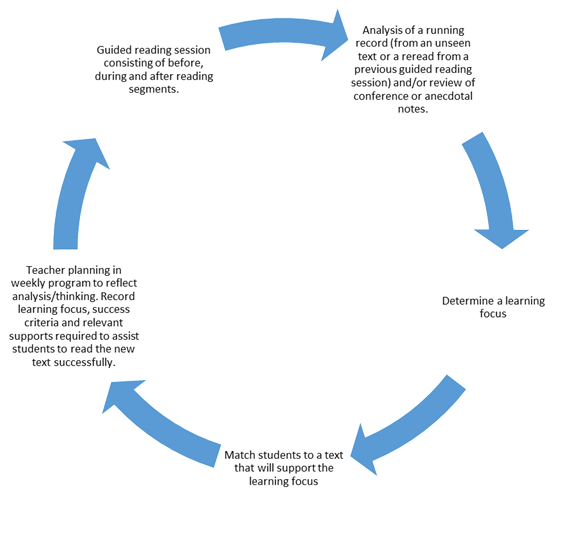 Guided reading sessions are made upwardly of 3 parts:
- before reading give-and-take
- independent reading
- after reading word
The main goal of guided reading is to help students utilize reading strategies whilst reading for meaning independently.
Why use guided reading
Guided reading is informed past Vygotsky's (1978) Zone of Proximal Development and Bruner's (1986) notion of scaffolding, informed by Vygotsky'due south research. The exercise of guided reading is based on the belief that the optimal learning for a reader occurs when they are assisted by an educator, or expert 'other', to read and understand a text with clear but limited guidance. Guided reading allows students to practise and consolidate effective reading strategies.
Vygotsky was particularly interested in the ways children were challenged and extended in their learning by adults. He argued that the most successful learning occurs when children are guided by adults towards learning things that they could not attempt on their own.
Vygotsky coined the phrase 'Zone of Proximal Development' to refer to the zone where teachers and students piece of work as children move towards independence. This zone changes as teachers and students motility past their present level of development towards new learning. (Source: Literacy Professional Learning Resource, Department of Didactics and Training, Victoria)
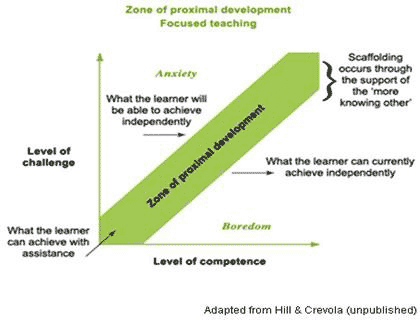
Guided reading helps students develop greater command over the reading procedure through the development of reading strategies which help decoding and construct meaning. The instructor guides or 'scaffolds' their students as they read, talk and think their way through a text (Department of Education, 1997).
This guidance or 'scaffolding' has been described by Christie (2005) as a metaphor taken from the building industry. It refers to the fashion scaffolds sustain and support people who are constructing a building.
The scaffolds are withdrawn once the building has taken shape and is able to support itself independently (pp. 42-43). Similarly, the teacher places temporary supports effectually a text such as:
- frontloading new or technical vocabulary
- highlighting the language structures or features of a text
- focusing on a decoding strategy that will exist useful when reading
- teaching fluency and/or
- promoting the different levels of comprehension – literal, inferential, evaluative.
One time the strategies have been practised and are internalised, the teacher withdraws the support (or scaffold) and the reader tin can feel reading success independently (Bruner, 1986, p.76).
When readers take the opportunity to talk, call up and read their fashion through a text, they build up a cocky-extending organization.
This system can then fuel itself; every time reading occurs, more learning about reading ensues. (Department of Teaching, Victoria, 1997; Fountas and Pinnell, 1996). Guided reading is a practice which promotes opportunities for the development of a self-extending system (Fountas and Pinnell, 1996).
Teacher'due south part in guided reading
Teachers select texts to match the needs of the group and then that the students, with specific guidance, are supported to read sections or whole texts independently.
Students are organised into groups based on similar reading power and/or similar learning needs determined through analysis of cess tools such equally running records, reading conference notes and anecdotal records.
Every educatee has a re-create of the same text at an instructional level (one that can normally be read with ninety–94% accuracy, run across Running Records). All students work individually, reading quietly or silently.
Selecting texts for EAL/D learners
Understanding EAL/D students' strengths and learning needs in the Reading and viewing way volition help with appropriate text selection. Teachers consider a range of factors in selecting texts for EAL/D students including:
- content which connects to prior knowledge and experiences, including culturally familiar contexts, characters or settings
- content which introduces engaging and useful new noesis, such as contemporary Australian settings and themes
- content which prepares students for future learning, east.one thousand. reading a narrative about a penguin prior to a scientific discipline topic about animal adaptations
- language at an accessible but challenging level ('simply right' texts)
- availability of support resources such as audio versions or translations of the text
- texts with a distinctive beat, rhyming words or a combination of direct and indirect spoken communication to assist with pronunciation and prosody
- the difficulty of the sentence structures or grammatical features in the selected text. Ideally, students read texts at an instructional level (texts where students achieve 90 per cent accurateness if they read independently) in social club to comprehend it readily. This is non always feasible, particularly at the higher levels of primary school. If the text is difficult, the teacher could alter the text or focus the reading on a department before exposing them to the whole text.
For more than information on texts at an instructional level, encounter: Running records
Students also demand repeated exposure to new text structures and grammatical features to extend their language learning, such equally texts with:
- different layouts and organisational features
- different sentence lengths
- unproblematic, compound or complex sentences
- a broad range of verb tenses used
- a range of complex word groups (noun groups, verb groups, adjectival groups)
- direct and indirect speech
- passive vocalization, e.g. Wheat is harvested in early autumn, before being transported to silos.
- nominalisation, e.g. The presentation of awards will have identify at 8pm.
EAL/D students larn almost the grammatical features as they ascend in authentic texts. For instance, learning nigh the class and function of passive sentences when reading an exposition text, and subsequently writing their own passive sentences.
All students in the class including EAL/D students will typically identify a learning goal for reading. Like all students, the learning needs of each EAL/D student volition be different. Some goals may exist related to the student'southward prior experience with literacy practices, such as:
- ways to incorporate reading into daily life at home
- developing stamina to read for longer periods of fourth dimension
- developing fluency to enable students to read longer texts with less endeavour.
Some goals may exist related to the nature of students' habitation language(s):
- learning to perceive, read and pronounce particular sounds that are non part of the home language, for example, in Korean there is no /f/ sound
- learning the direction of reading or the class of letters
- learning to recognise different give-and-take forms such as verb tense or plural if they are non role of the home linguistic communication.
For more information on advisable texts for EAL/D students, see: Languages and Multicultural Education Resource Eye
Major focuses for a teacher to consider in a guided reading lesson:
Earlier reading the teacher can
- activate prior knowledge of the topic
- encourage student predictions
- prepare the scene past briefly summarising the plot
- demonstrate the kind of questions readers ask near a text
- identify the pivotal pages in the text that incorporate the meaning and 'walk' through the students through them
- introduce whatsoever new vocabulary or literary linguistic communication relevant to the text
- locate something missing in the text and friction match to letters and sounds
- clarify meaning
- bring to attention relevant text layout, punctuation, chapter headings, illustrations, alphabetize or glossary
- clearly articulate the learning intention (i.e. what reading strategy students will focus on to assist them read the text)
- discuss the success criteria (e.grand. yous will know you accept learnt to ….. past ………)
During reading the teacher tin can
- 'listen in' to individual students
- find the reader's behaviours for evidence of strategy employ
- assist a student with problem solving using the sources of information - the utilise of pregnant, construction and visual information on extended text
- confirm a pupil'due south problem-solving attempts and successes
- give timely and specific feedback to help students achieve the lesson focus
- make notes about the strategies individual students are using to inform time to come planning and student goal setting; see Teacher'due south office during reading)
Later reading the teacher can
- talk about the text with the students
- invite personal responses such as request students to make connections to themselves, other texts or world knowledge
- return to the text to clarify or identify a decoding teaching opportunity such as work on vocabulary or give-and-take attack skills
- check a educatee understands what they have read by asking them to sequence, retell or summarise the text
- develop an understanding of an author's intent and awareness of alien interpretations of text
- inquire questions about the text or encourage students to ask questions of each other
- develop insights into characters, settings and themes
- focus on aspects of text organisation such as characteristics of a non-fiction text
- revisit the learning focus and encourage students to reflect on whether they achieved the success criteria.
Source: Department of Pedagogy, 1997
The teacher selects a text for a guided reading group by matching information technology to the learning needs of the small group. The learning focus is identified through the analysis of running records (text accuracy, cueing systems and identified reading behaviours), individual briefing notes or anecdotal records, run across Running Records).
Additional focuses for a teacher to consider for EAL/D students in a guided reading lesson
Earlier reading a fictional text, the instructor can
- orientate students to the text. Discuss the title, illustrations, and blurb, or look at the titles of the capacity if reading a chaptered book
- activate students' prior cognition near language related to the text. This could involve asking students to label images or translate vocabulary. Students could do this independently, with same-linguistic communication peers, family members or Multicultural Education Aides, if available
- use relevant artefacts or pictures to elicit language and knowledge from the students and encourage prediction and connections with like texts.
Earlier reading a factual text, the teacher can
- support students to brainstorm and categorise words and phrases related to the topic
- provide a structured overview of the features of a selected text, for example, the chief heading, sub headings, captions or diagrams
- support students to skim and scan to get an overview of the text or a specific slice of data
- support students to identify the text type, its purpose and language structures and features.
During reading the teacher can
- talk to EAL/D students nigh strategies they use when reading in their home language and encourage them to employ them in reading English language texts. Teachers can note these down and encourage other students to try them.
After reading the teacher can
- encourage EAL/D students to utilize their home linguistic communication with a peer (if available) to discuss a response to a instructor prompt then ask the students to share their ideas in English
- tape student contributions as pictures (east.g. a story map) or in English so that all students tin understand
- create practise tasks focusing on item sentence structures from the text
- set review tasks in both English language and home linguistic communication. Home language tasks based on personal reflection can help students develop depth to their responses. English language tasks may emphasise learning how to apply language from the text or the language of response
- inquire students to practise reading the text aloud to a peer to practise fluency
- ask students to create a bilingual version of the text to share with their family or younger students in the school
- enquire students to innovate on the text by changing the setting to a place in their domicile country and altering some or all of the necessary elements.
Inferring meaning
In this video, the teacher uses the do of guided reading to support a small group of students to read independently. Part 1 consists of the before reading discussion which prepares the small-scale group for the reading, and secondly, students individually read the text with teacher support.
In this video (Role 2), the teacher leads an after reading give-and-take with a modest grouping of students to cheque their comprehension of the text. The students re-read the text together. Prior to this session the children have had the opportunity to read the text independently and work with the instructor individually at their betoken of demand.
Point of view
In this video, the teacher leads a guided reading lesson on point of view, with a grouping of Level 3 students.
Text pick
The teacher selects a text for a guided reading group by matching information technology to the learning needs of the small grouping. The learning focus is identified through:
- assay of running records (text accuracy, cueing systems and identified reading behaviours)
- individual briefing notes
- or anecdotal records.
Text selection
The text chosen for the small group instruction volition depend on the didactics purpose. For example, if the purpose is to:
- demonstrate directionality - the teacher volition ensure that the text has a render sweep
- predict using the title and illustrations - the text chosen must support this
- brand inferences - a text where students can use their background cognition of a topic in conjunction with identifiable text clues to support inference making.
Text selection should include a range of:
- genres
- texts of varying length and
- texts that span dissimilar topics.
It is important that the instructor reads the text before the guided reading session to place the gist of the text, central vocabulary and text organisation. A learning focus for the guided reading session must exist adamant before the session. It is recommended that teachers gear up and document their thinking in their weekly planning so that the pedagogy can exist fabricated explicit for their students every bit illustrated in the examples in the information below.
Example ane
Students
Jessie, Rose, Van, Mohamed, Rachel, Candan
Text/Level
Tadpoles and Frogs, Author Jenny Feely, Program AlphaKids published by Eleanor Curtain Publishing Pty Ltd. ©EC Licensing Pty Ltd. (Level 5)
Learning Intention
We are learning to read with phrasing and fluency.
Success criteria
I can use the grouped words on each line of text to help me read with phrasing.
Why phrase
Phrasing helps the reader to sympathise the text through the grouping of words into meaningful chunks.
An case of guided reading planning and thinking recorded in a teacher's weekly program (See Guided Reading Lesson: Reading with phrasing and fluency)
Example 2
Students
Mustafa, Dylan, Rosita, Lillian, Cedra
Text/Level
The Merry Go Circular – PM Cherry, Beverley Randell, Illustrations Elspeth Lacey ©1993. Reproduced with the permission of Cengage Learning Australia. (Level 3)
Learning intention
Nosotros are learning to answer inferential questions.
Success criteria
I tin employ text clues and background data to help me answer an inferential question.
Questions equally prompts
Why has the author used bold writing? (Text clue) Can you wait at Nick's body linguistic communication on page11? Page 16? What do you lot notice? (Text clues) Why does Nick choose to ride upward on the horse rather than the machine or plane? (Background data on siblings, family dynamics and stereotypes about gender choices).
An case of the scaffolding required to assist early readers to answer an inferential question. This planning is recorded in the teacher's weekly program. (See Guided Reading Lesson: Literal and Inferential Comprehension)
More than examples
- an case of guided reading planning and thinking recorded in a teacher'southward weekly program, see Guided Reading Lesson: Reading with phrasing and fluency)
- questions to check for pregnant or disquisitional thinking should also exist prepared in advance to ensure the teaching is targeted and appropriate
- an example of the scaffolding required to assist early on readers to answer an inferential question. This planning is recorded in the teacher'southward weekly plan.
Information technology is important to choose a range of text types then that students' reading experiences are not restricted.
Quality literature
Quality literature is highly motivating to both students and teachers. Students prefer to learn with these texts and given the opportunity will choose these texts over traditional 'readers'. (McCarthey, Hoffman & Galda, 1999, p.51).
Research
Research suggests the quality and range of books to which students are exposed to such as:
- electronic texts
- levelled books
- student/instructor published piece of work Students should be exposed to the full range of genres we desire them to comprehend. (Knuckles, Pearson, Strachan & Billman, 2011, p. 59).
Considerations
When selecting texts for teaching purposes include: levels of text difficulty and text characteristics such equally:
- the length
- the degree of detail and complication and familiarity of the concepts
- the support provided past the illustrations
- the complexity of the judgement construction and vocabulary
- the size and placement of the text
- students' reading behaviours
- students' interests and experiences including home literacies and sociocultural practices
- texts that promote engagement and enjoyment.
For ideas about selecting literature for EAL/D learners, encounter: Literature
Teacher's role during reading
During the reading phase, it is helpful for the instructor to keep anecdotal records on what strategies their students are using independently or with some help. Comments are usually linked to the learning focus only can as well include an insightful moment or learning gap.
Learning instance
Students
Jessie
- finger tracking text
- uses some expression
- not pausing at punctuation
- some phrasing merely still some give-and-take by word.
Rose
- finger tracking text
- reading sounds smoothen.
Van
- reads with expression
- re-reads for fluency.
Mohamed
- uses pictures to help decoding
- give-and-take by word reading
- better later some modelling of phrasing.
Rachel
- tracks text with her eyes
- groups words based on text layout
- pauses at full stops.
Candan
- recognises commas and pauses briefly when reading clauses
- reads with expression.
 Teacher anecdotal records template example
Explicit educational activity and responses
There are a number of points during the guided reading session where the teacher has an opportunity to provide feedback to students, individually or as a small-scale group. To execute this successfully, teachers must be aware of the prompts and feedback they give.
Specific and focused feedback will ensure that students are receiving targeted strategies about what they need for time to come reading successes, encounter Guided Reading: Text Pick; Guided Reading: Instructor'south Office.
Examples of specific feedback
- I really liked the style you grouped those words together to make your reading sound phrased. Did information technology help yous empathize what yous read? (Meaning and visual cues)
- Tin you go dorsum and reread this sentence? I want yous to expect carefully at the whole word here (the beginning, center and end). What do yous detect? (Visual cues)
- As this is a long word, tin can you pause it upwards into syllables to try and work it out? Show me where yous would make the breaks. (Visual cues)
- It is important to pause at punctuation to assist you sympathize the text. Can you go back and reread this page? This fourth dimension I want you to concentrate on pausing at the full stops and commas. (Visual and significant cues)
- Look at the word closely. I can see it starts with a digraph y'all know. What sound does it brand? Does that assistance y'all work out the give-and-take? (Visual cues)
- This page is written in past tense. What morpheme would you lot expect to encounter on the end of verbs? Tin can you bank check? (Visual and structural cues)
- When you read something that does not make sense, you should go back and reread. What discussion could go there that makes sense? Can you cheque to run into if it matches the give-and-take on the page? (Meaning and visual cues)
Providing feedback to EAL/D learners
Specific feedback for EAL/D students may involve and build on transferable skills and cognition they gained from reading in some other language.
- I can meet you were thinking carefully about the meaning of that word. What information from the book did you utilise to help you guess the meaning?
- Exercise you know this give-and-take in your home linguistic communication? Permit's look information technology up in the bilingual dictionary to see what it is.
Reading independently
Independent reading promotes active problem solving and higher-order cerebral processes (Krashen, 2004). It is these processes which equip each student to read increasingly more complex texts over time; "resulting in amend reading comprehension, writing manner, vocabulary, spelling and grammatical development" (Krashen, 2004, p. 17).
It is of import to notation that guided reading is not round robin reading. When students are reading during the independent reading stage, all children must accept a re-create of the text and individually read the whole text or a meaningful segment of a text (e.g. a chapter).
Students also have an important office in guided reading as the teacher supports them to practise and further explore important reading strategies.
Earlier reading the student tin
- engage in a conversation about the new text
- brand predictions based on title, front embrace, illustrations, text layout
- activate their prior noesis (what do they already know about the topic? what vocabulary would they expect to see?)
- ask questions
- locate new vocabulary/literary language in text
- articulate new vocabulary and friction match to messages/sounds
- articulate learning intention and discuss success criteria.
During reading the student can
- read the whole text or section of text to themselves
- use concepts of impress to help their reading
- use pictures and/or diagrams to aid with developing pregnant
- problem solve using the sources of information - the use of meaning, (does it make sense?) structure (can we say it that way?) and visual information (sounds, letters, words) on extended text (Department of Teaching, 1997)
- recognise high frequency words
- recognise and use new vocabulary introduced in the before reading discussion segment
- use text user skills to help read dissimilar types of text
- read aloud with fluency when the teacher 'listens in'
- read the text more than once to establish significant or fluency
- read the text a second or tertiary time with a partner.
Subsequently reading the student can
- exist prepared to talk virtually the text
- discuss the problem solving strategies they used to monitor their reading
- revisit the text to further problem solve as guided by the teacher
- compare text outcomes to earlier predictions
- ask and answer questions about the text from the teacher and group members
- summarise or synthesise information
- discuss the author's purpose
- recall critically about a text
- brand connections between the text and cocky, text to text and text to globe.
Additional focuses for EAL/D students when reading independently
Before reading the pupil tin
-
- activate their dwelling house linguistic communication knowledge. What home language words related to this topic exercise they know?
During reading the student can
-
- refer to vocabulary charts or glossaries in the classroom to aid them recognise and recall the meaning of words learnt before reading the text
- use domicile language resources to help them understand words in the text. For example, translated word charts, bilingual dictionaries, aforementioned-language peers or family unit members.
After reading the student tin
-
- summarise the text using a range of meaning-making systems including English, habitation language and images.
Teacher anecdotal records template example
Peer observation of guided reading practise (for teachers)
Providing opportunities for teachers to acquire well-nigh teaching practices, sharing of evidence-based methods and finding out what is working and for whom, all contribute to developing a culture that volition make a divergence to student outcomes (Hattie, 2009, pp. 241-242).
When there has been defended and strategic work by a Principal and the leadership team to set up learning goals and targeted focuses, teachers take articulate direction about what to expect and how to go about successfully implementing core teaching and learning practices.
Ane fashion to monitor the growth of teacher capacity and whether new learning has become embedded is by setting upwardly peer observations with colleagues. It is a valuable tool to contribute to informed, whole-school approaches to teaching and learning.
The focus of the peer ascertainment must be adamant earlier the practice takes place. This ensures all participants in the process are articulate nigh the intention. Peer observations will only be successful if they are viewed as a collegiate activity based on trust.
According to Bryk and Schneider, loftier levels of "trust reduce the sense of vulnerability that teachers experience every bit they have on new and uncertain tasks associated with reform" and help ensure the feedback after an observation is valued (as cited in Hattie, 2009, p. 241).
To improve the practice of guided reading, peer observations tin can be bundled across Yr levels or inside a Year level depending on the focus. A framework for the observations is useful then that both parties know what it is that volition exist observed. It is important that the observer note down what they come across and hear the teacher and the students say and do. Evidence must exist tangible and not related to opinion, bias or estimation (Danielson, 2012).
Examples of prove relating to the guided reading practice might be:
- the words the teacher says (Today'southward learning intention is to focus on making sure our reading makes sense. If it doesn't, nosotros demand to reread and problem solve the tricky discussion)
- the words the students say (My reading goal is to break upwards a word into smaller parts when I don't know it to help me decode)
- the deportment of the instructor (Taking anecdotal notes as they listen to individual students read)
- what they can see the students doing (The group members all have their own re-create of the text and read individually).
Noting specific examples of engagement and practice and using a reflective tool allows reviewers to provide feedback that is targeted to the evidence rather than the personality. Finding time for face-to-face feedback is a vital stage in peer observation. Danielson argues that "the conversations following an observation are the all-time opportunity to engage teachers in thinking through how they can strengthen their practice" (2012, p.36).
It is through collaborative reflection and evaluation that teaching and learning goals and the embedding of new practice takes place (Principles of Learning and Didactics [PoLT]: Action Research Model).
Teacher Observation template case
In practice examples
For in do examples, see: Guided reading lessons
References
Bruner, J. (1986). Bodily Minds, Possible Worlds. Cambridge, MA: Harvard University Press.
Christie, F. (2005). Language Education in the Main Years. Sydney: University of New South Wales Press/University of Washington Press.
Danielson, C. (2012). Observing Classroom Practice, Educational Leadership, lxx(3), 32-37.
Department of Education, Victoria (1997). Didactics Readers in the Early Years. South Melbourne: Addison Wesley Longman Australia.
Department of Pedagogy, Employment and Training, Victoria (1999). Professional person Development for Teachers in Years 3 and iv: Reading. South Melbourne: Addison Wesley Longman Australia.
Dewitz, P. & Dewitz, P. (February 2003), They can read the words, but they can't empathise: Refining comprehension assessment. In The Reading Teacher, 56 (five), 422-435.
Duke, Northward.Thou., Pearson, P.D., Strachan, S.50., & Billman, A.M. (2011). Essential Elements of Fostering and Teaching Reading Comprehension. In S. J. Samuels & A. E. Farstrup (Eds.), What enquiry has to say about reading education (4th ed.) (pp. 51-59). Newark, DE: International Reading Association.
Fisher, D., Frey, Due north. and Hattie, J. (2016). Visible learning for Literacy: Implementing Practices That Work Best to Advance Student Learning. Thousand Oaks, California: Sage Publications.
Hall, K. (2013). Effective Literacy Teaching in the Early Years of Schoolhouse: A Review of Evidence. In Yard. Hall, U. Goswami, C. Harrison, S. Ellis, and J. Soler (Eds), Interdisciplinary Perspectives on Learning to Read: Culture, Cognition and Pedagogy (pp. 523-540). London: Routledge.
Hattie, J. (2009). Visible Learning: A synthesis of over 800 meta-analyses relating to achievement. Milton Park, Abingdon, Oxon: Routledge, Taylor and Francis Publishers
Hill, P. & Crevola, C. (Unpublished)
Krashen, S.D. (2004). The Ability of Reading: Insights from the Research (second Ed.). Portsmouth, NH: Heinemann.
McCarthey,Due south.J., Hoffman, J.V., & Galda, L. (1999) 'Readers in elementary classrooms: learning goals and instructional principles that tin inform practice' (Chapter three) . In Guthrie, J.T. and Alvermann, D.East. (Eds.), Engaged reading: processes, practices and policy implications (pp.46-80). New York: Teachers College Press.
Principles of Learning and Teaching (PoLT): Activeness Research Model Accessed
Scaffolding: Lev Vygotsky (June, 2017)
Vygotsky, 50.S. (1978). Heed in Society: The evolution of college psychological processes. Cambridge, MA: Harvard University Press.
Source: https://www.education.vic.gov.au/school/teachers/teachingresources/discipline/english/literacy/readingviewing/Pages/teachingpracguided.aspx
0 Response to "Guided Reading Activity Settling the West Answers"
Post a Comment